
Prologue: Why ‘International’ Is an Engineered Experience
When we say something is ‘international’ we typically mean it crosses borders: people, goods, ideas. What we seldom consider is the physical and intellectual craftsmanship that makes that crossing possible. From the steel corners of a shipping container to the microprint on a passport page, a network of designers, engineers and standardisers has quietly authored the modern international.
This article follows those hidden artisans — the people who codify legibility, durability and trust — and shows how seemingly mundane objects become global infrastructure. Their work is less about glamour and more about reproducibility: making one design work perfectly in Lagos, Lisbon and Lahore.
Containers: The Industrial Poetry That Standardised Global Trade
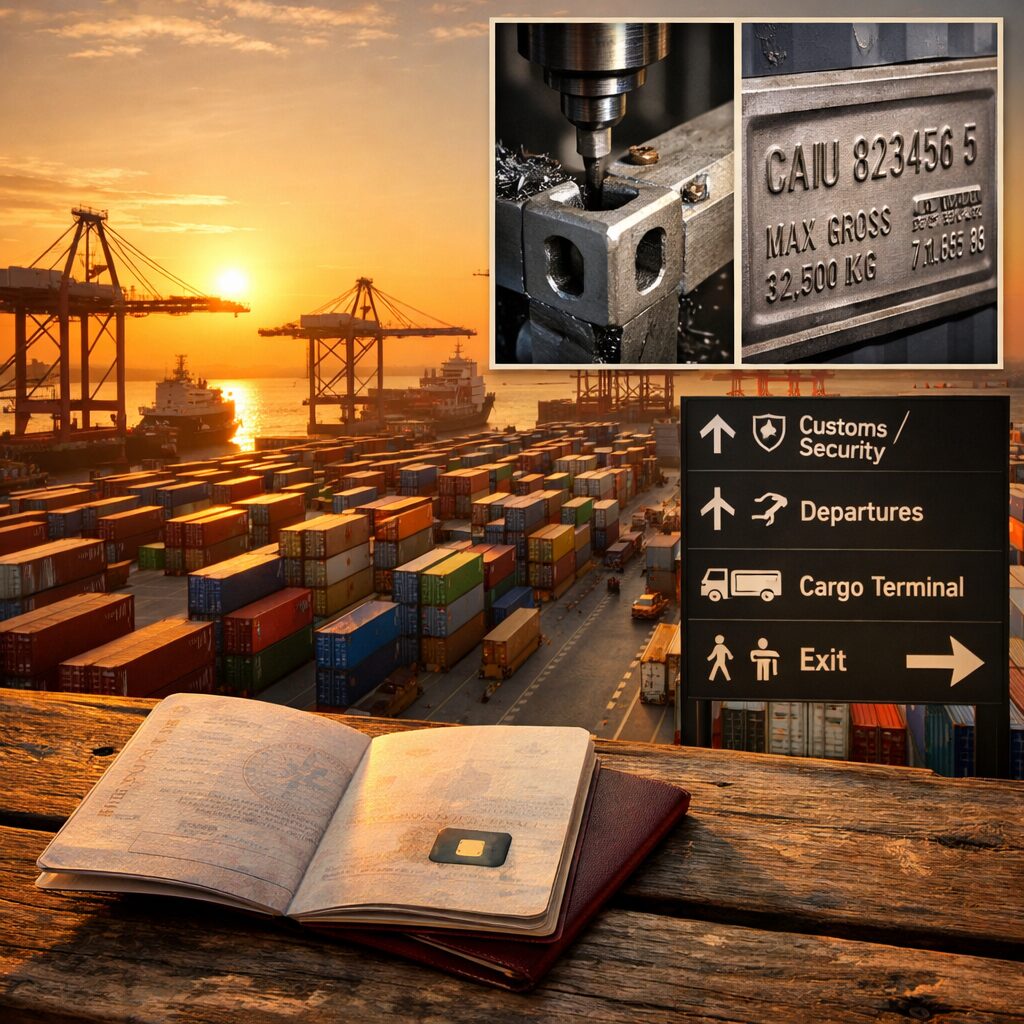
The 20th-century revolution that made the globe fungible began with a steel box. The standard 20-foot equivalent unit (TEU) is an exercise in ruthless optimisation: stowability, stackability, craneability and strength. The corner castings — those thick steel nodes at each corner — are the engineering equivalent of a language’s grammar: small, precisely positioned, and mandatory. They permit containers made in different factories, by different firms and in different decades, to interlock securely on a ship or a truck.
Design decisions that seem trivial — the height of a corrugation, the angle of a door hinge, the placement of ventilation holes — are outcomes of trade-offs between weight, rigidity and corrosion resistance. Paint chemistry itself is a form of engineering: marine-grade coatings must reflect sunlight, resist salt spray and advertise a carrier’s brand without cracking. The container’s universality is a triumph of repeatable craft; it turned bespoke freight into units of predictable geometry and behaviour, enabling ports, cranes and logistics software to be engineered around a single, global artefact.
Passports and the Micro-Engineers of Identity
A passport is a small book that must survive decades of handling while being supremely difficult to counterfeit. Achieving that requires a marriage of materials science, graphic design and cryptography. Paper makers collaborate with security printers to embed fibres, watermarks and holographic seals; typographers design fonts that are legible across scripts yet hostile to optical character recognition cheats; chip designers integrate secure microcontrollers that can sign data and resist tampering.
Every passport is also a lesson in cultural engineering. Designers balance national symbolism with international technical requirements such as ICAO standards for machine-readable zones. The result is a compact treaty between sovereign expression and interoperable verification: a passport must carry the weight of a country’s identity while being machine-readable at an airport border in another hemisphere.
Wayfinding: Typography, Colour and the Quiet Diplomacy of Signage
International airports and train stations are laboratories in cross-cultural legibility. Designers cannot rely on the traveller’s native language or familiarity with local iconography, so signage systems are crafted with extraordinary rigour. Typeface choices — think Frutiger for airports, Transport for roads — are selected not for style but for contrast, stroke width and recognisability at speed and from a distance.
Colour systems are engineered with human factors in mind: greens for movement, reds for prohibitions, blues for services. Pictograms are tested across continents to ensure they survive cultural variance. The result is a visual grammar that every passenger intuitively reads, a shared vocabulary that reduces friction and, crucially, can save lives in emergencies.
Protocols as Craft: The Engineering of Interoperability
Beyond objects lies a layer of protocols and standards — the intangible craftsmanship that keeps ‘international’ coherent. Organisations such as ISO publish technical specifications that force disparate industries to converge on common interfaces. The humble USB-C is a useful analogy: created to make chargers and devices interoperable, it relied on electrical engineering, mechanical tolerancing and political negotiation among manufacturers.
In international contexts, standards must respect different regulatory regimes and legacy systems. Engineers often prototype with backwards compatibility in mind, embedding fallbacks and versioning in hardware and software. That foresight is a form of craft: designing systems not just to work today, but to evolve without fracturing the global fabric they support.
Diplomatic Craft: Safes, Pouches and the Materiality of Trust
Diplomacy is often described in language and ceremony, but it relies on very physical artefacts. Diplomatic pouches — legally protected parcels that move between states — are products of both legal design and material craft. They must be tamper-evident yet transportable, subject to conventions that prioritise chain-of-custody integrity over commercial expediency.
Embassies themselves are engineered spaces. Architects design secure rooms, blast-resistant façades and discrete circulation routes that allow officials to move people and information safely. The craft here blends architecture, security engineering and the subtle demands of hospitality: spaces must be both impervious and welcoming, a rare duality that defines modern diplomacy’s material language.
Epilogue: The Future of International Craftsmanship
As digital identities, autonomous ships and climate-resilient infrastructure emerge, the craft of ‘international’ will shift yet again. Engineers will need to make systems legible across AI agents as well as human users; designers will craft icons consumed through augmented reality as much as steel and paper; standards organisations will mediate not only nations but platform proprietors.
The throughline remains: making something truly international is less a singular stroke of genius than a prolonged practice of refinement — small tolerances, tested materials, negotiated standards. The artisans of the international are not those who make headlines, but those who make the world work, quietly designing the seams that let societies interlock and travel, trade and talk across the planet.