
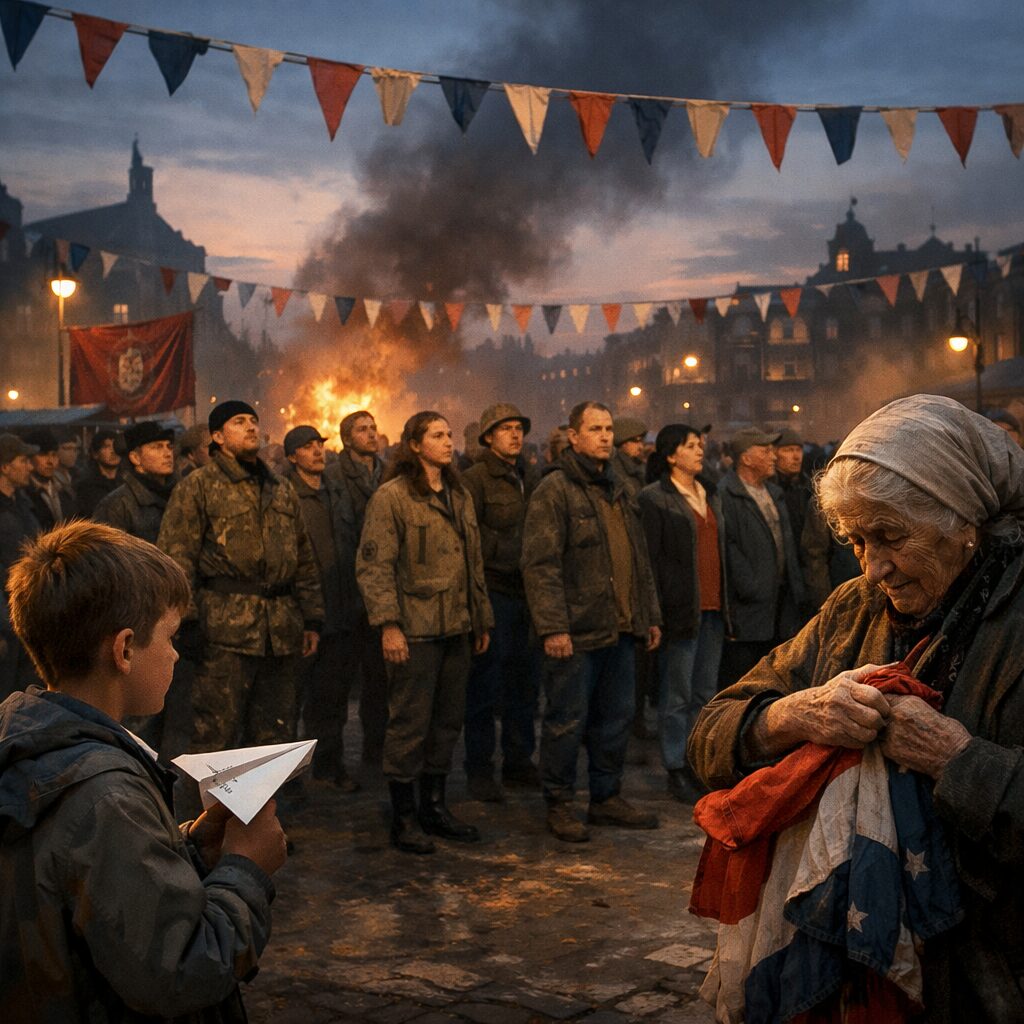
Introduction: The Strange Allure
War is usually written about as loss, strategy and geopolitics. Yet across centuries and cultures people have also been inexplicably drawn to it: to the thunder of mobilisation, the certainties it temporarily provides, the stories it spawns. This attraction is not a simple love of violence. It is a knot of psychological needs—of narrative, belonging, transcendence and spectacle—that turn war into something oddly magnetic.
This piece unpicks those threads. Combining evolutionary frames, neuroscience, cultural analysis and wartime memoirs, it seeks to explain why, in moments of unease or decline, societies sometimes lean towards conflict as though it were an elixir rather than a catastrophe.
Evolutionary Roots: Conflict as Signal and Selection
On the savannah, intergroup conflict produced clear, immediate payoffs: resources, territory and reproductive advantage. That legacy lingers in our psychology as an attunement to threats, rival coalitions and the moral clarity they often present. Human minds evolved to detect menace and commit to coalitions quickly; war amplifies both.
This does not justify modern violence. Instead it explains why the idea of collective struggle can feel instinctively meaningful. When institutions falter, ancient heuristics—trust the group, confront the enemy—can reassert themselves, giving people a dashed-off roadmap in chaotic times.
The Aesthetic and Narrative Pull: War as Story
Humans are storytelling animals. War provides unmistakable narrative architecture: heroes, villains, sacrifice, redemption and a clear before-and-after. This structure satisfies cognitive cravings for causality and coherence, especially when peacetime life feels fragmented.
Wartime narratives also play to aesthetic sensibilities—the drama of uniforms, the rhythm of marches, the poetry of slogans. Those sensory elements turn abstract geopolitics into emotionally resonant scenes. Even artists, journalists and filmmakers are drawn to war because it compresses moral complexity into compelling plotlines.
Belonging, Ritual and Masculinity
War is intensely social. It offers rituals—drill, ceremony, shared hardship—that create rapid intimacy and a deep sense of belonging. For many, that belonging corrects a loneliness modern life can’t assuage.
Ritualised danger also intersects with constructions of masculinity and honour. Societies with precarious institutions may channel anxieties into militarised rites of passage. The promise of recognition, status and clear social roles can be intoxicating, especially to young people searching for identity.
Neurochemistry: Reward, Fear and Flow
Conflict triggers potent neurochemical cascades: adrenaline sharpens focus, endorphins bind groups through shared stress, and dopamine rewards risk-taking and decisive action. These biochemical responses can produce states akin to ‘flow’—a clarity and absorption that veterans sometimes describe as paradoxically euphoric amid danger.
Those physiological rewards can create retroactive fondness for conflict experiences, skewing memory and feeding a cultural mythology that valorises war. Add alcohol, camaraderie and ritual, and the psychological loop reinforces itself.
Spectacle, Media and the Manufacture of Consent
Modern media industrialises the spectacle of war. Visuals, slogans and curated narratives convert complex conflicts into digestible frames that appeal to emotion more than reason. Social media accelerates this process, collapsing nuance into symbolic binaries and viral icons.
The media’s dramatization magnifies the psychological pulls described above. Spectacle makes war legible and thrilling at a distance, while simulacra—video games, films, memes—domesticate violence, sometimes blurring the boundary between entertainment and reality. That softening can normalise conflict in ways earlier generations never experienced.
The Politics of Longing: When Societies Prefer Crisis
There is a political economy to longing. Elites and demagogues often exploit the psychological affinities for order and meaning that war appears to offer. By reframing decline as a contest and uncertainty as a call to arms, leaders can rally loyal coalitions and marginalise dissent.
This dynamic explains why societies in prolonged transition may flirt with militarisation: the promise of decisive action feels like a remedy for complex systemic problems. The danger is that the psychological comforts of conflict mask long-term destruction and render alternatives—deliberation, redistribution, institution-building—less visible.
Reclaiming Meaning Without Violence
Understanding why people are drawn to war gives us tools to offer alternatives. Ritual, belonging and narrative can be provided through civic renewal, public arts, meaningful labour and rites of community service. Attention to young people’s needs for status and recognition can divert energies from militarism into construction rather than destruction.
Policymakers and cultural leaders can deliberately design institutions that deliver the psychological satisfactions war promises—cohesion, purpose, clarity—without the bloodshed. That work is slow and unglamorous, but it is the only sustainable antidote to the allure of conflict.
Conclusion: The Paradox of Attraction
The attraction to war is not a moral failing confined to a few. It is a mosaic of ancient impulses and modern aesthetics, neurochemistry and social design. Recognising this complexity strips away romantic myths without rendering people as villains; instead, it reveals needs that must be met if societies are to choose peace.
If we want to reduce the draw of war, we must address those needs deliberately—repairing institutions, creating civic rituals, and offering narratives of meaning that do not depend on annihilation. Only then can the thunder of mobilisation be heard for what it is: an alarm bell, not an answer.