
Introduction: An Uncomfortable Premise
War is normally framed as an ineffable human tragedy: loss of life, displacement, shattered infrastructure and ruined economies. Yet if we strip away moral language for a moment and adopt the cold lens of a logistics officer, an economist or an industrial designer, a different pattern emerges. Conflict compresses timeframes, concentrates resources, eliminates redundant processes and forces rapid experimentation. Those effects can, paradoxically, produce measurable savings of time, money and effort in narrow, technical senses.
This article does not seek to sanitise war or to endorse conflict. Rather, it aims to explore the lesser-discussed mechanics by which war has historically accelerated certain efficiencies. These are hidden, often ugly trade-offs: gains that come bound up with large, lasting costs. Understanding them helps explain why peacetime institutions sometimes emulate wartime practices — and why policy-makers must be careful about the moral and social price of those efficiencies.
Industrial Acceleration and Economies of Scale
One of the most tangible ways war ‘saves’ time and money is by forcing dramatic scaling of production. When governments demand millions of units of a single product — from rifles to vaccine doses — manufacturers reorganise entire supply chains, standardise parts, and squeeze out inefficiencies.
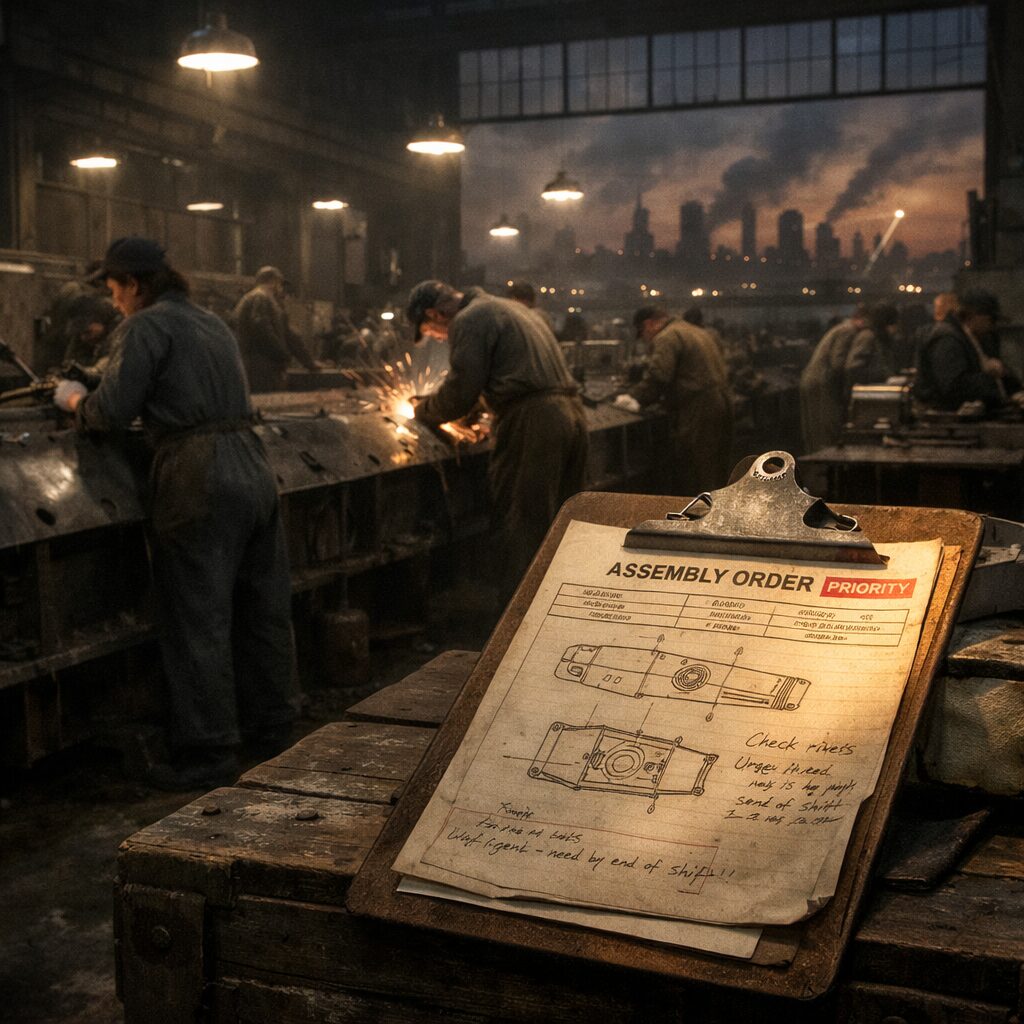
Historically, wartime demand enabled mass-production techniques that would have been uneconomical in peace. In the Second World War, American factories shifted from bespoke manufacturing to assembly-line production on an unprecedented scale, dramatically reducing per-unit costs for ships, aircraft and vehicles. The time savings came from simplified designs, standardised components and round-the-clock shifts; the monetary savings resulted from fixed cost amortisation across vastly larger volumes.
Those wartime economies of scale leaked into civilian markets afterwards. The same machine tools, trained workforce and production philosophies underpinned post-war consumer booms, making automobiles, appliances and pharmaceuticals cheaper and faster to make. From a purely transactional view, war acted as a brutal, state-funded accelerator of industrialisation.
Bureaucratic Streamlining and Centralisation
War concentrates authority. Faced with existential threats, states tend to centralise decision-making: procurement, logistics and personnel management are routed through fewer channels, often led by empowered technocrats. That concentration can cut administrative overhead and shorten decision cycles.
Examples include simplified contracting rules for essential materiel, emergency delegations of authority to military commanders, and suspension of protracted civil procurement procedures. The result is a sharply reduced timeline for getting projects off the ground. Where peacetime procurement might take years of tendering, negotiation and litigation, wartime procurement can deliver capability in months — albeit with higher risk and lower transparency.
Some public-sector reformers have attempted to mimic these efficiencies in peace by creating ‘rapid acquisition’ arms or emergency procurement frameworks. The danger, of course, is institutionalising exception-based powers that were intended for short-term use. The trade-off lies between agility and accountability.
Hidden Fiscal ‘Savings’ and Accounting Tricks
Wars often create accounting illusions of savings. Governments facing wartime finance pressures will reassign budgets, defer maintenance, and reprice risk in ways that appear to reduce expenditure in the short term.
For instance, essential infrastructure deferred during conflict — roads, schools, or routine hospital upgrades — can make a government’s books look leaner under an emergency budget. Similarly, the mobilisation of existing civilian assets for military use (ships requisitioned for transport, factories converted for munitions) reduces immediate capital outlays. Insurance obligations are frequently waived under martial arrangements, and governments accept losses private actors would otherwise insure against.
These are not real savings but temporal shifts of cost. The bills often arrive later as wartime wear accumulates, deferred maintenance compounds and social services struggle post-conflict. Still, from an administrative viewpoint, war provides a way to prioritise and reallocate funds rapidly, a way that some finance ministers grudgingly admire.
Technological Leapfrogging and Effort Substitution
Conflict has a track record of forcing leapfrog innovations that reduce effort in the long term. Under extreme pressure, engineers abandon cautious incrementalism in favour of bold experimentation. Radar, jet engines, digital computing and even the internet have direct lineages to defence research.
These innovations often deliver efficiency gains in both military and civilian spheres: automated manufacturing reduces labour input, improved communications cut coordination time, and advanced logistics software trims fuel and inventory costs. In hospitals, wartime advances in trauma care and infection control have reduced mortality and shortened recovery times for decades after the guns fall silent.
The mechanism is substitution of effort — investing concentrated intellectual and material labour into a technology during a compressed timeframe to reduce human effort afterwards. That substitution is socially valuable but ethically fraught: the impetus for progress was destruction, not benign curiosity.
Social Reconfiguration: Labour, Skills and Mobility
War reshapes labour markets abruptly. Large-scale mobilisation removes able-bodied workers from civilian roles, opening vacancies that accelerate women’s entry into work, expand apprenticeships and reshape skill distributions. Training programmes that compress skill acquisition to meet military needs can later be repurposed for civil industry, lowering the effort and cost of workforce development.
For example, pilots trained for wartime service returned to commercial aviation, which benefitted from their skills and reduced training needs. Vocational training developed to support defence production seeded entire trades in peacetime economies. The social mobility engendered by wartime labour realignment thus provides a downstream reduction in hiring and training effort — again, at the cost of short-term disruption and long-term social trauma.
These dynamics help explain why economies often rebalance faster after wars than after depressions: the human capital adjustments are sudden and extensive, producing an adaptable workforce more quickly than gradual market changes would.
Ethical Costs and the Illusion of Net Benefit
Every argument about efficiencies from war must be counterbalanced by ethical and macroeconomic costs. Lives lost, communities broken, environmental devastation and the destabilisation of institutions are not offset by faster production lines or new technologies. The ‘savings’ highlighted above are often transient, concentrated among particular actors (states, contractors) and financed by irreversible human suffering.
Moreover, many wartime efficiencies rely on coercion, secrecy and the suppression of dissent. That makes them incompatible with democratic norms and civil liberties. Borrowing wartime practices in peace risks eroding accountability and inflating the power of the centralised state — a cost that does not appear on balance sheets but is real nonetheless.
Recognising the mechanisms by which war accelerates efficiency should therefore inform policy in two ways: first, to channel beneficial innovations into peaceful, transparent pathways; and second, to guard against normalising the governance shortcuts that only function under duress.
Conclusion: Salvaging Lessons Without Sanitising the Cause
War undeniably catalyses certain efficiencies: faster production, centralised decision-making, compressed innovation cycles and workforce realignment. These dynamics ‘save’ time, money and effort in narrow technical senses, and their legacies can be visible for generations.
But the moral ledger is not balanced by these gains. The task for policymakers, innovators and historians is to learn how to replicate the beneficial mechanics — rapid iteration, effective coordination, scalable production — without relying on conflict as the engine of change. Building peacetime institutions that can flex like wartime ones, yet remain accountable and humane, is the real challenge: to make the time, money and effort savings obtainable by design rather than by disaster.