
When War Becomes a Forecast: The Rise of Predictive Conflict
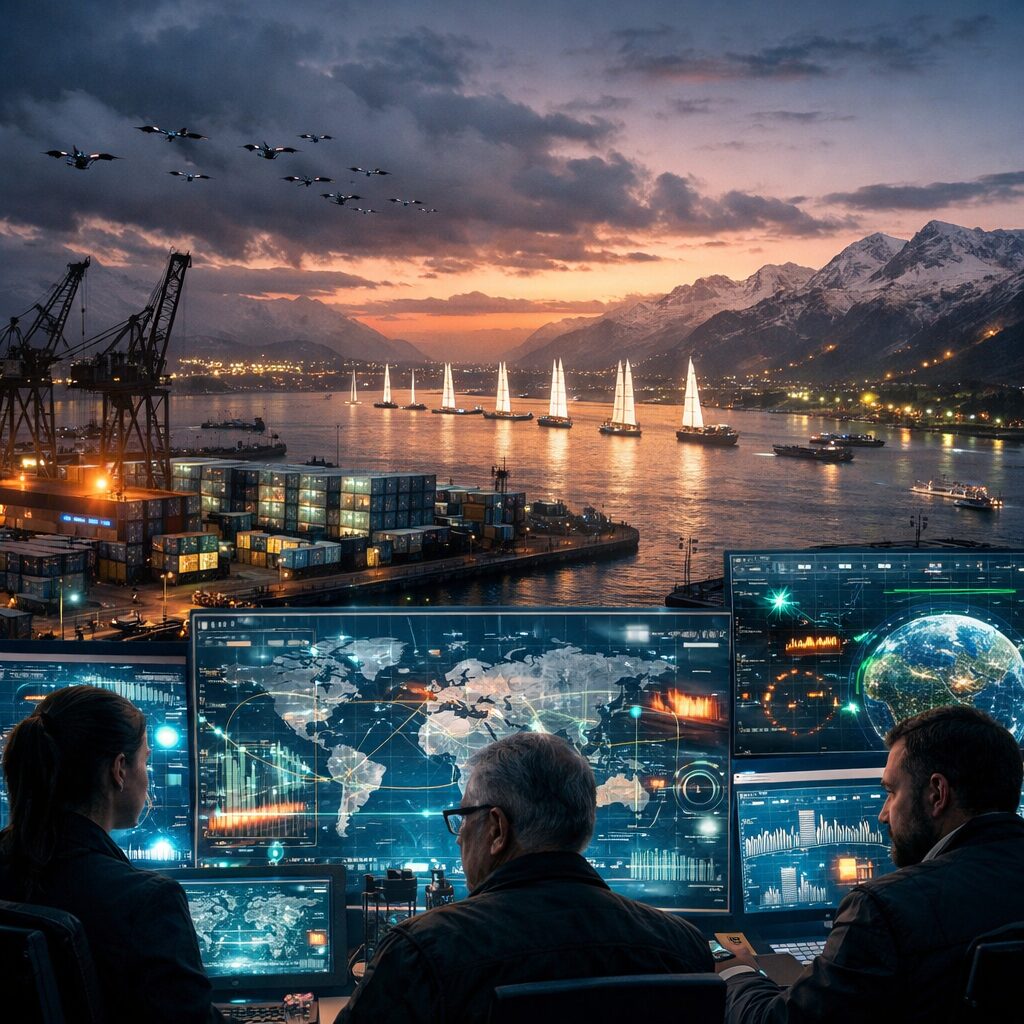
War is shifting from kinetic surprise to algorithmic inevitability. Military planners and private firms now run vast fleets of digital twins — simulations that model societies, economies and climates in astonishing detail. These models don’t just predict where violence might erupt; they suggest which strategies will produce desired political outcomes with minimal direct force.
This makes conflict pre-emptive and surgical in new ways. Instead of mass mobilisation, future contestation will often be a matter of nudging markets, manipulating supply chains and deploying targeted disinformation to alter election forecasts or commodity prices. The result is a conflict landscape where the tipping point matters more than the battlefield, and where the most lethal weapon may be a well-timed economic forecast or an AI-induced market shock.
Commercialising Confrontation: Privateers, Tech Firms and the Marketisation of War
The private sector’s role in war has expanded from mercenaries and defence contractors to platforms and algorithms that enable contest. Cloud providers, social-media companies and logistics firms now possess capabilities that can tilt conflicts without firing a shot.
This creates perverse incentives: firms optimise for continuity, market share and shareholder returns, not necessarily human security. Expect more ‘conflict-as-a-service’ offerings — subscription-based intelligence, predictive targeting, mercenary AI — where nation-states outsource risk and plausibly deniable operations. Regulation and norms will lag behind, making private corporate policy the de facto architecture of many future conflicts.
The Climate-Made Battlefield: Scarcity, Migration and New Frontiers
Climate change is remapping strategic priorities. Diminishing freshwater, arable land and habitable coastline will concentrate human movement and economic activity into new corridors, turning them into hotspots for strategic competition.
Rather than traditional frontlines, expect friction zones: ports, river basins, glacier-fed valleys, and shipping lanes made precarious by sea-level rise and polar melt. Nations and non-state actors will militarise infrastructure — dams, desalination plants, data centres — transforming civilian systems into defensive bulwarks and lucrative targets. This creates conflicts where environmental management and military doctrine are inseparable.
Human-Machine Teams and the Changing Face of Violence
Autonomy will proliferate across air, sea, cyber and logistical domains, but the decisive battles will be about teaming. The side that develops resilient human-machine collaboration — operators who can intervene, reinterpret and improvise — will hold the advantage.
Ethical constraints and laws of armed conflict will strain under autonomy. Expect hybrid doctrines where human oversight is nominal and legal frameworks are stretched through tiered responsibility. The battlefield will be increasingly layered: kinetic strikes, swarms of low-cost drones, and invisible cyber operations orchestrated by AIs that learn from every engagement. Yet human judgement will remain the fulcrum — not because machines cannot kill, but because war remains a contest of intent and meaning.
Information Scarcity and the Attention Economy of Violence
In the 21st century, control of narratives is as strategic as control of territory. Attention is currency: the ability to command global attention can amplify a tactical gain into a strategic victory or sink a conventional advantage into political disaster.
Future conflict will be fought inside attention platforms. Tactical acts will be timed for virality, legal decisions leveraged as information weapons, and human rights narratives weaponised to shape sanctions and alliances. Countermeasures will include truth fences — legal, technical and cultural mechanisms intended to throttle disinformation — but they will also produce new forms of censorship and asymmetry in information access.
Law, Norms and the Invisible Arms Races
As technology diffuses, normative frameworks will become the only real barrier to escalation. Expect jurisdictional competition over standards: who defines what counts as an act of war in cyberspace, or what constitutes acceptable use of autonomous weapons?
This norm-setting will be contested across courts, standard-setting bodies and trade agreements. States and corporations will engage in legal signalling — drafting contracts, industry standards and bilateral agreements to lock in advantage. The next arms race will be legal and bureaucratic as much as material, with international law struggling to keep pace with rapid innovation.
Designing Peace as Infrastructure: The Quiet Frontline
If future war prizes the anticipatory, then peace must become infrastructural and proactive. Resilience will not be a boutique policy but a public utility: redundant supply chains, decentralised energy, robust civic education and distributed governance nodes that resist capture.
Investing in such architectures — climate-resilient ports, localised food systems, transparent digital institutions — is strategically preventive. The smartest states will treat peacebuilding like defence procurement, funding long-term social and technical projects that make aggressive coercion costly and less likely to succeed.
What Citizens Can Expect and How to Respond
Ordinary people will feel these changes through new vulnerabilities: compromised services, staged scarcity, or targeted economic coercion. But they will also gain tools: decentralised finance, community-led sensors, and civic cryptography that can resist some forms of manipulation.
Civic literacy will become strategic. Knowing how algorithms shape feeds, how supply chains work, and how local governance functions will no longer be specialised skills for a few — they will be part of resilient citizenship. Democracies that invest in public technological competence and social cohesion will be better placed to deter coercion and prevail in the attention wars ahead.