
Why study ‘why war works’?
Most public conversations treat war as either a moral catastrophe or a political failure. Framing the question instead as “why war works” forces a shift from blame to mechanism: what systemic features make the use of organised violence an effective instrument for achieving political ends? This piece does not argue that war is desirable. Rather, it examines the social, cognitive and technological architectures that historically make warfare an unusually efficient tool for states, movements and coalitions — and what researchers have discovered about those architectures in the past three decades.
Approaching war as a socio-technical phenomenon opens a different set of data: not just casualty counts and treaties, but networks, incentives, information flows, supply chains, metabolic rates of economies, and human psychology under threat. Pulling those threads together reveals why, from a functional point of view, war often delivers rapid, decisive change.
Evolution, signalling and coalition dynamics
A surprising insight from evolutionary biology and behavioural ecology is that organised violence rests on evolved signalling systems and coalition psychology. Coalitions require credible commitment — individuals must demonstrate willingness to bear costs for a group’s goal. Fighting acts as the ultimate costly signal: it reliably separates committed members from free-riders because the physiological and social costs of combat are immediate and observable.
Experimental work in behavioural economics and anthropology — including costly-signalling models and ethnographic studies of tribal raiding — shows the same pattern at multiple scales. Fighting creates cohesive in-groups and delegitimises opponents through ritualised aggression and public sacrifice. That cohesion translates into rapid mobilisation and lower transaction costs for collective decision-making, which, in turn, shortens the timescale for political change compared with protracted bargaining.
Information asymmetries, compression and the fog of war
War ‘works’ in part because it exploits and reshapes information asymmetries. Military operations compress time: decisions made under pressure reveal preferences and tolerances that peacetime diplomacy obscures. This compression can eliminate strategic ambiguity quickly, forcing adversaries to reveal capabilities and political thresholds.
Network science and information theory offer formal models for this process. Combat and coercive signalling transform opaque opponent intent into observable behaviours, reducing Bayesian uncertainty for decision-makers. Moreover, the fog of war itself is not merely ignorance; it is a strategic resource. Deception, misinformation and compartmentalised command structures leverage asymmetric information to generate tactical advantage — a lesson borne out in modern cyber and electronic warfare research.
Logistics, industrial base and the science of endurance
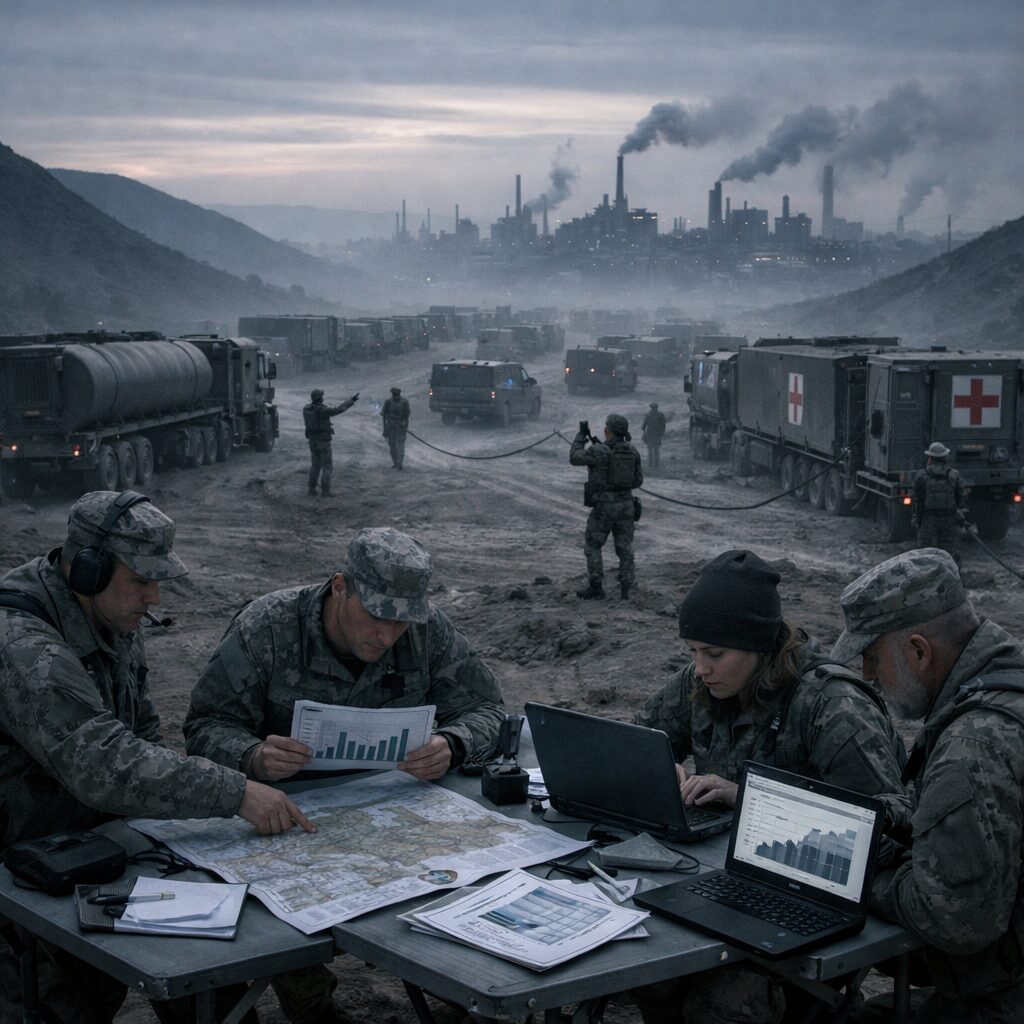
Beyond men and bullets, the decisive variable in prolonged conflict is often logistics. Analysts from military history to operations research emphasise the ‘science of endurance’: the capacity to sustain tempo through supply chains, manufacturing throughput, fuel logistics and medical systems. Quantitative studies of 20th-century wars show that attrition is frequently a function of industrial substitution rates — how fast a belligerent can replace lost equipment and materiel.
Operations research, optimisation theory and systems engineering have turned this into measurable science. Value-chain modelling, queueing theory and inventory control explain why a smaller, better-organised economy can outlast a numerically superior but logistically brittle opponent. Recent work integrating climate models with supply-chain analysis also shows that environmental stressors can tip endurance calculations in unexpected ways.
Technology, thresholds and the multiplier effect
Technological change amplifies why war can be effective. Innovations create discontinuities in cost-benefit calculations: a new weapon system, sensor network or cyber capability can abruptly raise the cost of resistance for an opponent. Research on military revolutions — from gunpowder to precision-guided munitions — demonstrates that technology lowers the marginal cost of coercion and raises the political return on force.
But technology is a multiplier, not a panacea. Studies of asymmetric warfare show that superior tech must be matched by doctrine, training and social legitimacy to translate into strategic success. Machine learning and autonomous systems now introduce another layer: speed of decision-making. When algorithms reduce human reaction times, the side that integrates them effectively can further compress the opponent’s decision horizon, making coercion more decisive.
Data, models and predictive limits
Large-N datasets and computational models have improved our ability to predict conflict onset and outcomes, but they also reveal durable limits. Statistical models — from civil war risk indexes to network contagion analyses — identify structural drivers (state capacity, resource competition, regime type). However, counterfactuals are difficult: historical analogues and agent-based simulations sometimes underperform because small contextual differences cascade into divergent outcomes.
This empirical humility matters. Where quantitative tools excel is in clarifying probabilistic mechanisms: how mobilisation thresholds, per-capita logistics capacity and information asymmetries interact to make coercion more or less likely to succeed. Policymakers can use these models to anticipate tipping points and design interventions that alter the underlying mechanics rather than merely responding to symptoms.
Ethical and policy implications: changing the ‘machinery’ of war
Understanding the science behind why war works creates practical levers for prevention. If cohesion and costly signalling make violence effective, then institutions that provide credible, non-violent outlets for status, redistribution and grievance redress can undercut that mechanism. If information compression and logistics favour decisive force, transparency regimes, international inspections and supply interdictions can blunt the operational advantage.
On the other hand, insights into technology and endurance can also accelerate arms races if misapplied. Responsible policy must therefore couple scientific diagnosis with governance: export controls, norms for autonomous systems, climate-resilient infrastructure and international mediation architectures. In short, studying the mechanics of war is not a recipe for replication — it is a toolkit for dismantling the structural conditions that make organised violence an effective instrument of politics.