
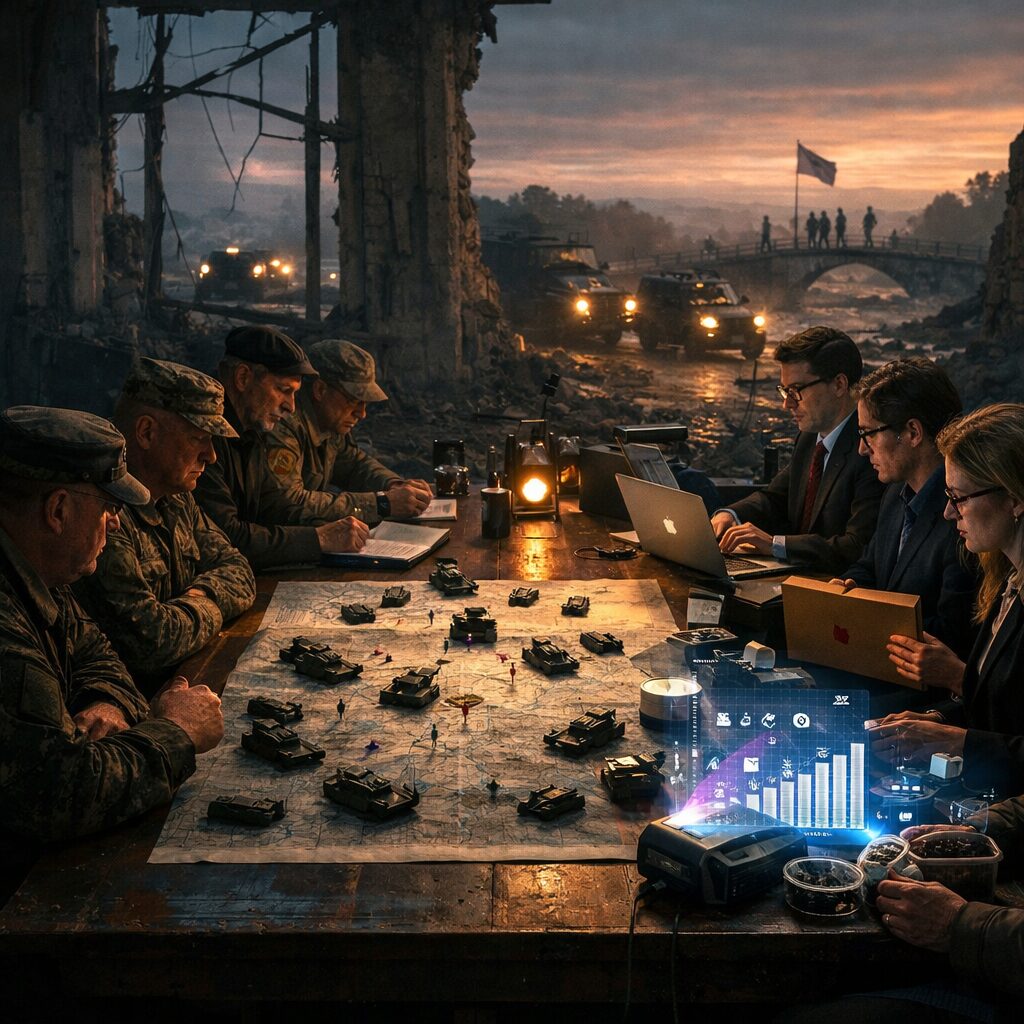
War as a Product in a Competitive Landscape
Imagine war sitting on a marketplace shelf, priced, reviewed and compared to alternatives. That metaphor reveals a useful truth: states and non-state actors choose between tools, not simply between fighting or not. Military force competes with sanctions, cyber operations, propaganda, blockades, legal action and negotiated settlement. Each ‘product’ has attributes—speed, visibility, reversibility, collateral damage, domestic political payoff—that buyers weigh.
When leaders opt for armed conflict they are often responding to constraints in the other markets: sanctions that would take months to bite, legal avenues that lack enforcement, or cyber campaigns that offer deniability but not decisive results. War’s comparative advantage has historically been its ability to produce rapid, unambiguous change in territory or regime. Yet that advantage comes with large fixed and continuing costs: conscription, institutional militarisation, moral legitimacy losses and reconstruction liabilities.
Sanctions, Law and Economic Coercion: Slow-Burn Competitors
Economic coercion and legal instruments are the patient competitors of war. Sanctions, trade embargoes and international litigation wield time as a weapon. They excel in democracies where domestic pressure and market access matter, and where multilateral institutions can be mobilised. Their drawback is latency; the target can outlast the pain or pivot economically.
Law, when enforceable, alters incentives permanently without bullets. Yet compliance relies on power asymmetries and the credibility of institutions. Where court rulings lack execution force, they operate as signalling mechanisms rather than decisive solutions. In some cases sanctions and legal pressure crowd in violence instead of supplanting it, particularly if elites choose to securitise nationalist sentiment to retain authority.
Cyber and Information Operations: The Lightweight Rivals
Cyber operations and information warfare are the nimble challengers to conventional war. They are low-cost, low-barrier and scalable, appealing to actors seeking plausible deniability. Cyber attacks can degrade infrastructure, manipulate markets and erode public trust with relative impunity. Information campaigns shape perceptions long before any soldier sets foot on foreign soil.
Their limitation is physicality: they seldom capture territory or permanently depose a regime. Instead they change the rules of competition by lowering the entry costs to conflict and fostering a constant state of grey-zone pressure. The result is competition that looks like attrition in the cognitive domain—slow erosion of consensus and legitimacy rather than dramatic, kinetic outcomes.
Proxy Conflict, Private Military Companies and Market Fragmentation
When direct war is too costly, actors outsource. Proxy forces, militias and private military companies (PMCs) act as intermediaries, splitting the costs and obscuring accountability. This fragmentation creates a market for violence: contractors bid with different value propositions—deniability, rapid deployment, niche capabilities.
The competitive landscape becomes messier. PMCs compete with state militaries on efficiency and agility, but they also introduce agency problems. Short-term contracts favour immediate victories over durable peace, and the proliferation of suppliers can prolong instability by incentivising ongoing demand for their services.
Peacebuilding, Development and Climate Adaptation: The Long-Term Competitors
Sustained alternatives to war live in the slow lanes of peacebuilding, development and climate resilience. Investments in governance, economic opportunity and ecological stability reduce the underlying drivers of violent conflict. These competitors offer higher long-term returns but require patience, coordination and credible institutions to deliver.
Their marketability is poor politically: voters and leaders rarely reward the intangible successes of prevention. Nevertheless, in a world where climate shocks, resource scarcity and migration intensify, these approaches become increasingly competitive. Preventive diplomacy combined with targeted development can create conditions where war is no longer a rational choice for most actors.
Audience Choice: Domestic Politics and the Consumer of Violence
Who chooses between these options? Domestic publics, elites, militaries and international partners all act as consumers with different preferences. Democracies face electoral constraints that bias toward short, victorious campaigns or non-kinetic measures that avoid casualties. Authoritarian regimes may prefer coercion or clandestine operations to secure control without surrendering legitimacy.
The ‘purchase’ is political as much as strategic. Wars sometimes succeed because they sell better domestically: they simplify narratives, generate rallying effects and provide visible signs of resolve. Alternatives often struggle in the market of public opinion where immediacy and drama trump slow-building solutions.
The Cost Equation and the Future of Competition
Comparative advantage in conflict is shifting. Technological diffusion lowers the cost of lethal violence for non-state actors while climate change multiplies friction points. At the same time, global interdependence makes high-intensity interstate war riskier economically. The emerging equilibrium will be hybrid: combinations of sanctions, cyber pressure, proxies and limited kinetic actions calibrated to avoid escalation while achieving political aims.
Policymakers facing this landscape need market literacy: evaluate substitutes and complements to force, price long-term prevention properly, and recognise how new entrants—tech companies, PMCs, climate migrants—reshape the competitive set. War will not vanish as an option, but its dominance as the default instrument of statecraft is increasingly contested.
When Alternatives Fail: Choosing the Last Resort
There are moments when alternatives have been exhausted or are unavailable: genocides, imminent large-scale aggression or systemic collapse can make force the least bad option. The ethical calculus changes when inaction equals catastrophe. Even then, treating war as the last resort implies a catalogue of expectations—limited objectives, exit strategies and post-conflict reconstruction plans—that many historical wars lacked.
Recognising war as one product among many should compel tighter decision rules. If leaders must choose the most destructive instrument, they owe the public a clear comparison with the alternatives and evidence that non-violent options were pursued and failed.