
A different map: International as social infrastructure
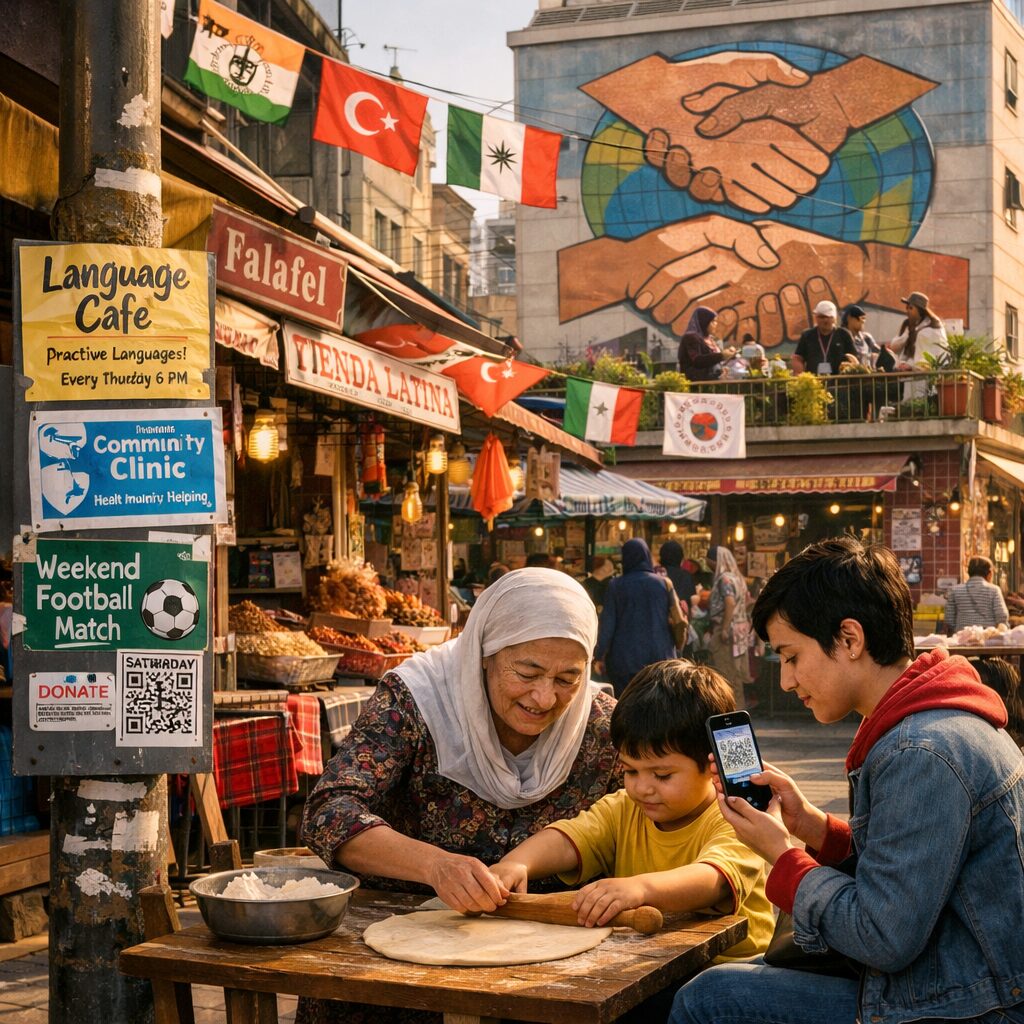
When we speak of the international, we usually imagine states, treaties or travel. Yet increasingly the most resilient “international” is not a treaty but a street corner, a WhatsApp group, a cooperative bakery or a university student union that stitches people together across borders. These micro-infrastructures—places and protocols where people meet, trade, teach and celebrate—operate like urban capillaries: modest in scale, vital in function.
Look at markets such as London’s Brick Lane or Nairobi’s Gikomba. They began as local responses to migration and commerce and evolved into transnational nodes: supply chains, social networks and cultural platforms that sustain communities at home and abroad. The international here is not abstraction; it is the bench where an elderly immigrant teaches a teenager their mother tongue, the shared fridge in a community kitchen, the digital forum that coordinates mutual aid between cities after a disaster. These are forms of community-building that are subtle but durable.
Diaspora design: how remittances and projects reconfigure hometowns
Remittances have long been measured in dollars; less studied is how they are measured in trust and civic capacity. Across West Africa, South Asia and Latin America, diaspora groups are pooling funds not just for household support but for clinics, schools and micro-enterprises. Those investments reconfigure local governance by creating parallel, accountable institutions that often outpace the state in responsiveness.
Programmes that link diasporas to municipal planning—such as the Participatory Budgeting pilots and UNESCO-backed heritage projects—turn outward connections into inward civic capital. The result is hybrid civic space: infrastructures co-owned by a local community and an international constituency. That co-ownership embeds international relations into everyday life and makes global ties a resource for local solidarity.
Language, rituals and the art of belonging
Language classes, religious festivals, and culinary clubs are often dismissed as cultural trinkets. Yet they are powerful technologies of belonging. When a municipality endorses a multilingual sign policy, or when a university funds a cultural festival, it does more than celebrate difference: it acknowledges multi-layered citizenship.
Consider university international student unions that persist beyond graduation as alumni networks, mentorship circles and local business incubators. Or the spontaneous rituals that form in refugee communities—street football tournaments, improvised memorials, pop-up markets—that become the scaffolding for public life. These rituals teach reciprocity across origin and host communities, translating international ties into local norms of care.
Digital commons and the protocolisation of solidarity
The digital realm has created its own international civic architecture. Open-source platforms, decentralised fundraisers and cross-border volunteering apps standardise how people help each other at speed. Unlike the old aid models that flowed from north to south in a one-way vector, contemporary digital commons enable peer-to-peer solidarity: small donors in Seoul can sponsor a community library in Accra; refugee-led mapping projects can inform municipal planning in European cities.
This is not technological determinism. What matters is the emergent practice—the protocols that communities adopt: transparent governance, shared moderation, recurring commitments. When those protocols are robust, they translate digital connection into long-term civic capacity on the ground. Examples range from municipal hackathons that include diaspora coders to blockchain experiments for communal land titles. The common thread is design for inclusion rather than spectacle.
Sport, art and the diplomacy of everyday encounters
Sporting leagues, theatre collectives and music ensembles have long been soft diplomacy tools; their quieter power lies in producing repeated, low-stakes encounters that normalise cooperation. Local football clubs with immigrant players rework neighbourhood identities; cross-border art residencies generate shared vocabularies that outlast festival weeks.
These practices are not luxuries. In neighborhoods with rising polarisation, a shared choir or a community sports day can defuse tensions and create cross-cutting ties that buffer against political shocks. When international actors fund such initiatives, their role is catalytic rather than directive—the goal is to seed local ownership so the community remains the steward of relationships.
Measuring what matters: indicators of an international community
Traditional metrics—trade volumes, visa counts—miss the subtler signs of international community-building. New indicators need to track reciprocity, multi-sited governance, and networked trust: frequency of cross-border civic exchanges, persistence of diaspora-funded public goods, multilingual signage and recurrence of shared rituals.
Cities and NGOs are beginning to experiment with these metrics. They help reframe policy away from assimilation-versus-control debates and toward investments in connective tissue: community hubs, translation services, mutual-aid platforms and legal clinics that help migrants assert rights. Such investments compound: every new public space where people meet increases the probability of further cooperative ventures.
A future made of neighbourhoods, not nation-states
If the next decade is defined by climate migration, digital nomadism and cross-border entrepreneurship, the reality that matters most will be how communities adapt. The international that strengthens civil life will be local first—a patchwork of neighbourhood-level innovations that are networked globally. This is a pragmatic cosmopolitanism: a politics of doing—building libraries, running clinics, setting up co-ops—and of making international ties accountable to local needs.
Policymakers and funders can accelerate this by treating internationalism as infrastructure rather than charity: fund the spaces and protocols where people meet, support designs that transfer ownership to local actors, and measure success in years of sustained engagement rather than one-off headline events. Whatever the label—diaspora investment, transnational civic tech, cultural diplomacy—the enduring achievement will be communities that are both rooted and connected, capable of exchanging resources, rituals and responsibilities across borders.