
The invisible scaffolding: how standards keep the world stitched together
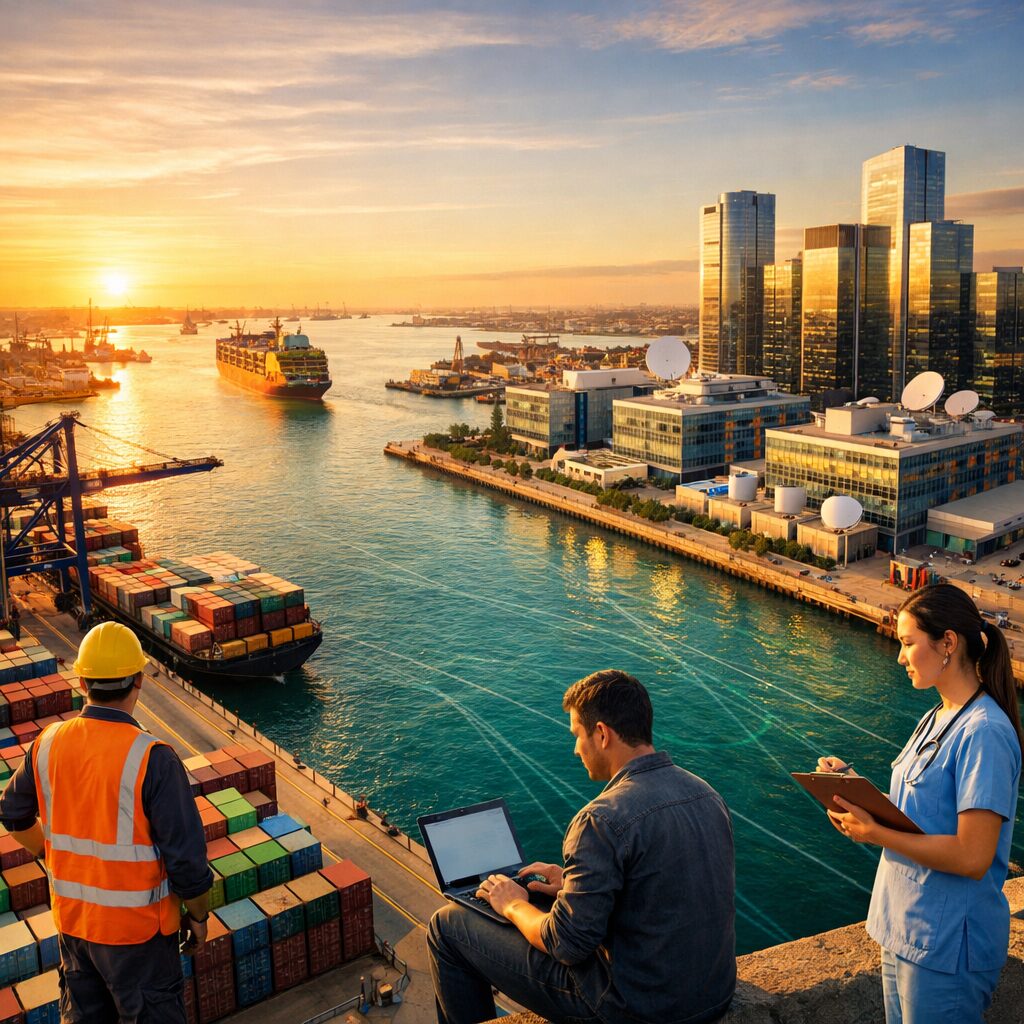
We think of ‘international’ as embassies, flags and flights. Rarely do we see the scaffolding that makes modern life interoperable: standards, protocols and codes that hum in the background. When your phone shows a contact’s name correctly in Japanese, when a hospital in Lagos decodes a pathology report from a lab in Milan, or when bulk cargo is invoiced across ports in Colombo and Rotterdam, it is because international technical systems exist. Organisations such as ISO, the W3C and the Unicode Consortium are not abstract technocracies; they are the translators and civil engineers of global civilisation. Their work stops fragmentation: a single character set prevents digital apartheid, a shared shipping container standard keeps goods flowing, and common aviation rules mean planes can move people safely across multiple sovereign skies. The international rarely feels political when it is merely functional, yet its absence would instantly make the world chaotic.
Micro-international: diasporas, codebases and emotional remittances
International is not only about treaties and trade balances. Look closer and you find micro-international networks that reshape cities, startups and families. Diasporas transmit more than money; they move practices, recipes, languages and trust networks that power informal credit, recruitment and entrepreneurship. Similarly, open-source software is an international commons: a bug fixed by a developer in Accra improves a product used in Santiago. Those contributions are social exports — a quiet form of diplomacy that binds strangers into productive communities. Emotional remittances, from video calls to shared rituals, sustain migrants and maintain bi-directional cultural influence, producing hybrid identities that alter politics and markets in ways formal statistics struggle to capture.
Regulatory patchwork and the rise of cross-border norms
National laws are no longer the sole axes of regulation. Companies, platforms and civil society craft cross-border norms that fill gaps left by slow-moving states. Privacy regimes, environmental standards and AI governance are increasingly shaped by transnational coalitions, industry standards and court precedents in other jurisdictions. Consider how the European Union’s data rules ripple worldwide: firms change global architectures rather than fragment services by market. Similarly, a city declaring a climate emergency can push suppliers and insurers to adapt long before national policy follows. The international layer has become a pressure valve and a pilot lab simultaneously, enabling rapid policy diffusion but also creating opportunities for regulatory arbitrage — and hence the modern world’s true diplomatic currency is credibility, not merely treaties.
Infrastructure you never see: cables, routes and the geography of dependence
Undersea cables, satellite constellations and shipping corridors are the physical arteries of interdependence. These arteries are geopolitically vulnerable yet almost invisible to everyday awareness. The Red Sea disruptions in recent years showed how a narrow stretch of water can throttle global trade; a single damaged cable can slow financial markets and strand internet users across continents. Nations and corporations are investing in redundancy, but the distribution of these assets often reflects power asymmetries. Understanding ‘international’ thus requires reading maps at a different scale — one that shows chokepoints, redundant routes and the places where cooperation is essential or conflict likely. Resilient internationalism is built not only on goodwill but on diversified, redundant networks.
Culture as soft infrastructure and the politics of mutual intelligibility
Soft power is often dismissed as fluff, but cultural compatibility is an operational necessity. Mutual intelligibility — shared frames, narratives and norms — reduces transaction costs in diplomacy, commerce and science. Translation is not merely linguistic; it is interpretive labour that allows policy, law and research to be reused across contexts. International cultural institutions, festivals, academic exchanges and media ecosystems cultivate that common ground. When these systems fray, misinformation and mistrust fill the space, making coordination far harder. Investing in interpretive capacities, from translators to context-aware AI, is an investment in the global operating system of cooperation.
Why this matters now: stakes and choices in a multipolar era
The acceleration of technology and the diffusion of power make the international layer both more necessary and more contested. Climate thresholds, pandemic preparedness, digital integrity and supply-chain resilience are problems that cannot be solved within single borders. Yet the tools we rely on were built in an era of relative Western dominance and must be reimagined to be equitable and durable. The choice before us is subtle: do we strengthen shared systems that accept pluralism and mutual dependency, or retreat into brittle national solutions that amplify fragility? Recognising the international as infrastructure — practical, technical and cultural — reframes the debate. It moves the conversation from abstraction to decisions about maintenance, access and who gets a seat at the table.